Vals 1955
Music and Lyrics: Fulvio Salamanca, Enrique Alessio, Alberto Echagüe
Orchestra: Juan D’Arienzo
Singer: Alberto Echagüe
Performance: Buenos Aires, August 9, 1955, RCA Victor label, internal record #ERT-3611
Curated and Translated by Luigi Seta
Tango Talks! (El tango nos habla)
No nos dejemos engañar por el ritmo festivo de este vals, el cual encierra un profundo drama. Aquí los tres autores decidieron proponer una gran dicotomía entre la música, profundamente alegre y el mensaje de la historia.
Quizás lo más difícil sería representar esta situación cuando se lo baila. Aceptemos el desafío de estos tres genios!

Let us not be deceived by the festive rhythm of this tango vals, which contains a profound drama. Here the three authors decided to make a deep dichotomy between its happy music and the message of the story.
Perhaps the most difficult thing would be to represent this situation when we dance to it. Let's accept the challenge of these three geniuses!
© Luigi Seta

Nota: la letra fue toma da directamente de la grabación.
About one of the Composers / Acerca de uno de los Compositores
Fulvio Salamanca
(Real name: Fulvio Werfil Salamanca)
Fue una de las grandes figuras de la época dorada del tango, como instrumentista de notable manejo del piano, por su innato sentido rítmico sincopado que alcanzó cotas altas en la orquesta de Juan D'Arienzo, a la cual se incorporó en 1940, cuando aún no había cumplido los 20 años.
He was one of the great figures of the golden age of tango, instrumentalist of remarkable handling of the piano, by its innate syncopated rhythmic sense that reached high heights in the orchestra of Juan D'Arienzo, to which it was incorporated in 1940, when he still had not turned 20.
Manejaba con absoluta soltura el instrumento, a la edad de 12 años ya era profesor de piano. D'Arienzo lo descubre en una gira por Córdoba, haciéndolo bajar a Buenos Aires para tantear su posible ingreso en la orquesta que más éxito tenía en esos momento.
He performed with absolute ease the instrument, at the age of 12 he was already a piano teacher. D'Arienzo discovers him on a tour of the Cordoba province, making him go down to Buenos Aires to test his possible entry in the orchestra that was the more successful at that time.
Lo notable en Salamanca fue no sólo su juventud cuando se sentó al piano de la orquesta, sino su capacidad para retener en la cabeza todos los tonos, los solos, las marcaciones y la conjunción con los “fueyes” (bandoneones) y los violines de la orquesta. Fulvio, poco a poco desarrolló su propio estilo, dentro de la marcada marcha milonguera de D'Arienzo, tan requerida por los bailarines.
What was remarkable in Salamanca was not only his youth, but when he sat at the piano of the orchestra, his ability to retain in his head all the tones, the solos, the marking and the conjunction with the "fueyes" (bandoneons) and the violins of the orchestra. Fulvio, little by little developed his own style, within the marked milonguero march of D'Arienzo, so required by the dancers.
Sin lugar a dudas, su ciclo con D'Arienzo fue fundamental en su carrera, no solo por su interpretación en una orquesta tan popular y exitosa, sino también por la experiencia lograda junto al líder. Dejó 380 grabaciones con El Maestro, algunas antológicas, por las cuales aquellos totalmente apasionados siguieron la fiesta en la pista de baile. No nos dejemos engañar por el ritmo festivo de este vals, que encierra un profundo drama.
Undoubtedly his cycle with D'Arienzo was fundamental in his career, not only because of his playing in an orchestra so popular and successful, but also because of the experience achieved alongside the leader. He left 380 recordings with El Maestro, some anthological, for which those totally passionate that followed the beat on the dance-floor. Let’s not to be fooled by the festive rhythm of this vals, which bares a deep drama.
Porque Tú Me Lo Pides
Vals 1955
Castellano:
Pondré largas distancias
Entre tu amor y el mío,
Me cegaré los ojos
Para no verte más.
Arrasaré mis labios
Para que no te nombren,
Y así, quizás un día
De mí te olvidarás.
Como tú me lo pides
Me marcharé muy lejos,
En mi pecho desnudo
Clavaré tu puñal.
No escucharás mi grito
Ni te diré un reproche,
Porque vivir sin verte
Es morir, nada más.
Qué remolino negro
Nos arrastró en su danza,
Fue tu amor, fue tu sangre
O espejismo nomás.
Que mentida esperanza
Nos engañó un momento,
Qué luz deslumbradora
Nos vuelve a separar.
Comprendo tu tortura
No turbaré tu vida,
Lo que pasó fue un sueño
De locura, nomás.
Nadie sabrá que fuiste
Pasionalmente mía,
Y que tu amor se abraza
En mi misma ansiedad.
Como tú me lo pides,
Porque te quiero tanto,
Por tu boca que tiembla
Y no puedo besar.
Pondré largas distancias
Entre tu amor y el mío,
Y así, quizás un día
De mí te olvidarás.
Qué remolino negro
Nos arrastró en su danza,
Fue tu amor, fue tu sangre
O espejismo nomás.
Que mentida esperanza
Nos engañó un momento,
Qué luz deslumbradora
Nos vuelve a separar.
|
English:
I will put long distances
Between your love and mine,
I will blind my eyes
To not see you anymore.
I will raze my lips
So they can not name you,
And so, maybe one day
You will forget me.
As you ask me
I will go far away,
In my bare chest
I will plunge your dagger.
You will not hear my scream
I will not tell you a reproach,
Because live without seeing you
It is dying, nothing more.
What a black swirl
dragged us in its dance,
It was your love, it was your blood
Or just a mirage.
What a hopeful lie
Fooled us for a moment,
What a dazzling light
Is separating us again.
I understand your torture
I will not disturb your life,
What happened was a dream
Of madness, maybe.
No one will know you were
Passionately mine,
And that your love embraces
My same anxiety.
As you ask,
Because I love you so much,
Because your trembling mouth
That I can not kiss.
I will put long distances
Between your love and mine,
And that way, maybe, one day
You will forget me.
What a black swirl
dragged us in its dance,
It was your love, it was your blood,
Or just a mirage.
What a hopeful lie
Fooled us for a moment,
What a dazzling light
Is separating us again.
|
Note: lyrics were taken directly form the performance.
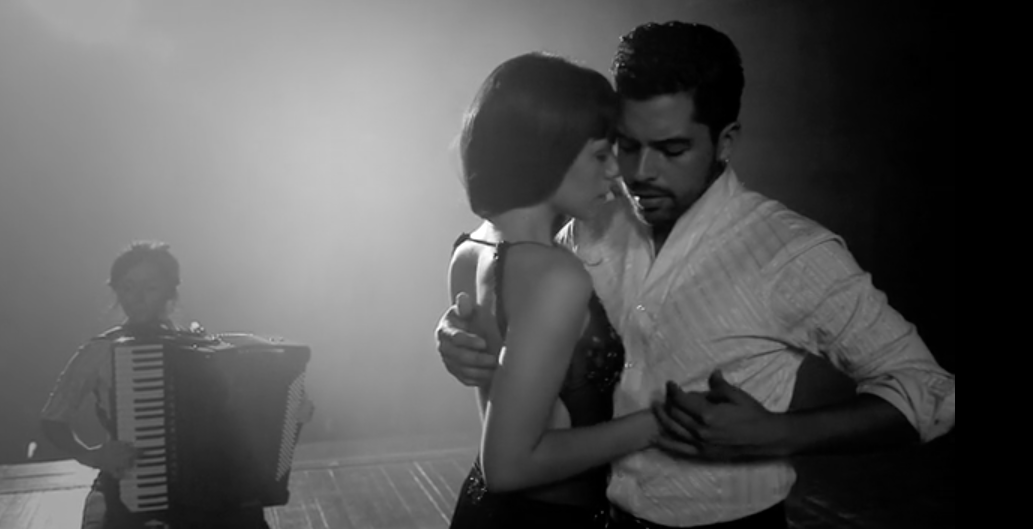
Danced by Anayansi Macherel and Alexander Sossa
Alexander Sossa es el vice campeón de Milonga y el tercer lugar en las categorías de Tango y Vals en el Concurso Metropolitano de Tango de Buenos Aires en 2015. En 2014, ganó el lugar en el Campeonato Mundial de Tango final. Anayansi Macherel, obtuvo el tercer lugar en el Metropolitan Tango of BsAs en 2012.
Juntos proponen un Tango Milonguero y de Salón en la más pura tradición porteña, proyectando un sentimiento preciso que permite la transmisión de la técnica del tango vals, que definitivamente ellos dominan. ¡Bravo!
Denmark, Copenhagen, Milonga Den Blâ Lotus,
January 9th 2016
Alexander Sossa is the Milonga's vice champion and third place in the Tango and Vals categories at the Buenos Aires Tango Metropolitan Contest in 2015. In 2014, he won sixth place in the Tango World Championship final. Anayansi Macherel, she got the third place at the Metropolitan Tango of BsAs in 2012.
Together they propose a Tango Milonguero and Salon in the purest Buenos Aires tradition, projecting a precise feeling that allows the transmission of the tango waltz technique, which they definitely dominate. Bravo!